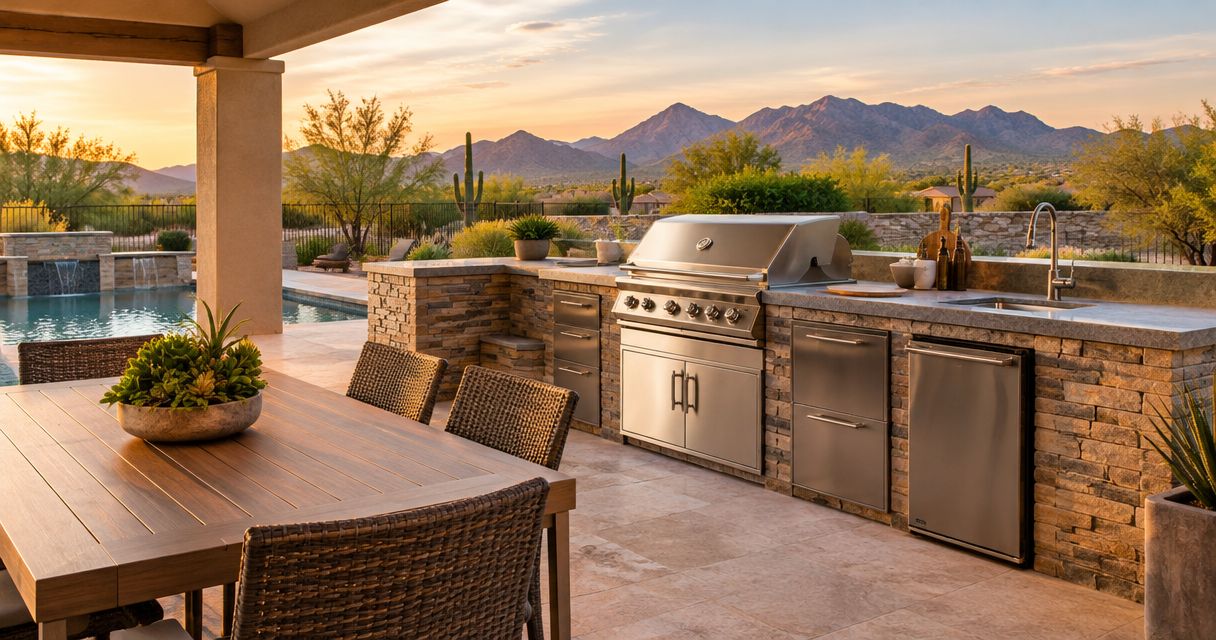
Best overall countertop: outdoor-rated porcelain. Best for natural-stone character: granite. Best for cabinet fronts: stainless steel. The best outdoor kitchen materials for Casa Grande backyards in 2026 combine weather-appropriate surfaces with a sound base, drainage, and appliance clearances—not one material used everywhere.
- The best outdoor kitchen materials for Casa Grande backyards start with outdoor-rated porcelain countertops and weather-appropriate cabinet construction.
- Granite suits homeowners who want natural stone and accept periodic maintenance.
- Stainless steel suits outdoor cabinet fronts; masonry suits permanent island bases.
- First Choice Renovation LLC is best for homeowners seeking coordinated remodeling and maintenance guidance.
For help connecting your backyard plans with repairs or broader remodeling, contact First Choice Renovation LLC. The business serves homeowners and businesses across Pinal County; describe the outdoor work you need and confirm the proposed scope before selecting materials.
Why this matters
An outdoor kitchen exposes finishes to direct sun, airborne dust, cooking grease, and rain. A surface that works inside a house is not automatically suitable outside. Shade helps with comfort, but it does not turn an indoor-only countertop or cabinet into an exterior product.
Choose the complete assembly before choosing the color. Your countertop needs suitable support, your cabinets need weather-appropriate construction, and your cooking appliances need the clearances stated in their installation instructions. A durable surface cannot compensate for trapped water or an unsupported cutout.
For a 2026 project, distinguish between replacing finishes on an existing island and building a new cooking area. Those scopes require different decisions about utilities, foundations, access, and approvals.
What makes the best outdoor kitchen materials?
Use these criteria to compare materials before reviewing finishes:
- Documented exterior suitability: Confirm that the specific product—not merely the material category—is approved for its intended outdoor use.
- Sun exposure: Check exterior-use guidance for the surface, pigments, coatings, adhesives, and sealants. Consider how shaded and exposed areas differ.
- Heat and appliance compatibility: Follow appliance instructions for surrounding materials, ventilation, and clearances. A noncombustible finish alone does not establish a safe installation.
- Water management: Plan slopes, joints, cabinet protection, and drainage so water does not collect inside the assembly.
- Cleaning and maintenance: Compare grease removal, sealing requirements, grout care, and the accessibility of serviceable components.
- Repairability: Ask how a damaged panel, tile, door, or countertop section would be repaired without dismantling unrelated work.
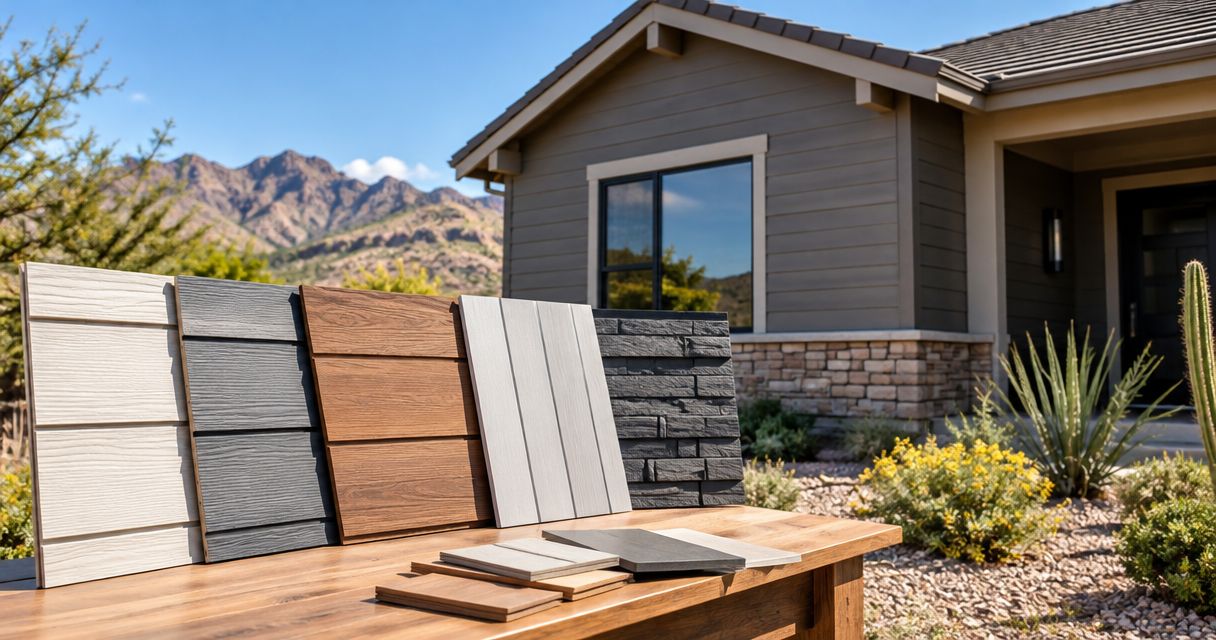
Collect 3 material samples for your preferred countertop finish. View them in the actual backyard, both under shade and in sunlight, rather than deciding entirely from a showroom display.
Outdoor kitchen materials at a glance
These picks serve different parts of an outdoor kitchen. Porcelain and granite compete as countertops; stainless steel, masonry, tile, and concrete address other construction needs. The ranking therefore works as a component-selection guide, not a claim that every material replaces every other material.
| Rank | Material | Best for | Standout feature | Key limitation |
|---|---|---|---|---|
| 1 | Outdoor-rated porcelain slab | Low-maintenance countertops | Nonporous surface with minimal grout joints | Edges and cutouts need careful fabrication and support |
| 2 | Granite | Natural-stone countertops | Natural variation and substantial stone appearance | Porosity and maintenance vary by slab |
| 3 | Stainless steel | Outdoor cabinet fronts | Washable metal surfaces without wood finishes | Fingerprints, scratches, and reflected glare |
| 4 | Concrete masonry | Permanent island bases | Noncombustible structural enclosure | Heavy construction with limited flexibility |
| 5 | Exterior-rated porcelain tile | Decorative backsplashes | Washable surface with varied finish choices | Grout joints add maintenance |
| 6 | Broom-finished concrete | Work-area paving | Continuous surface around the cooking zone | Cracking and drainage require planning |
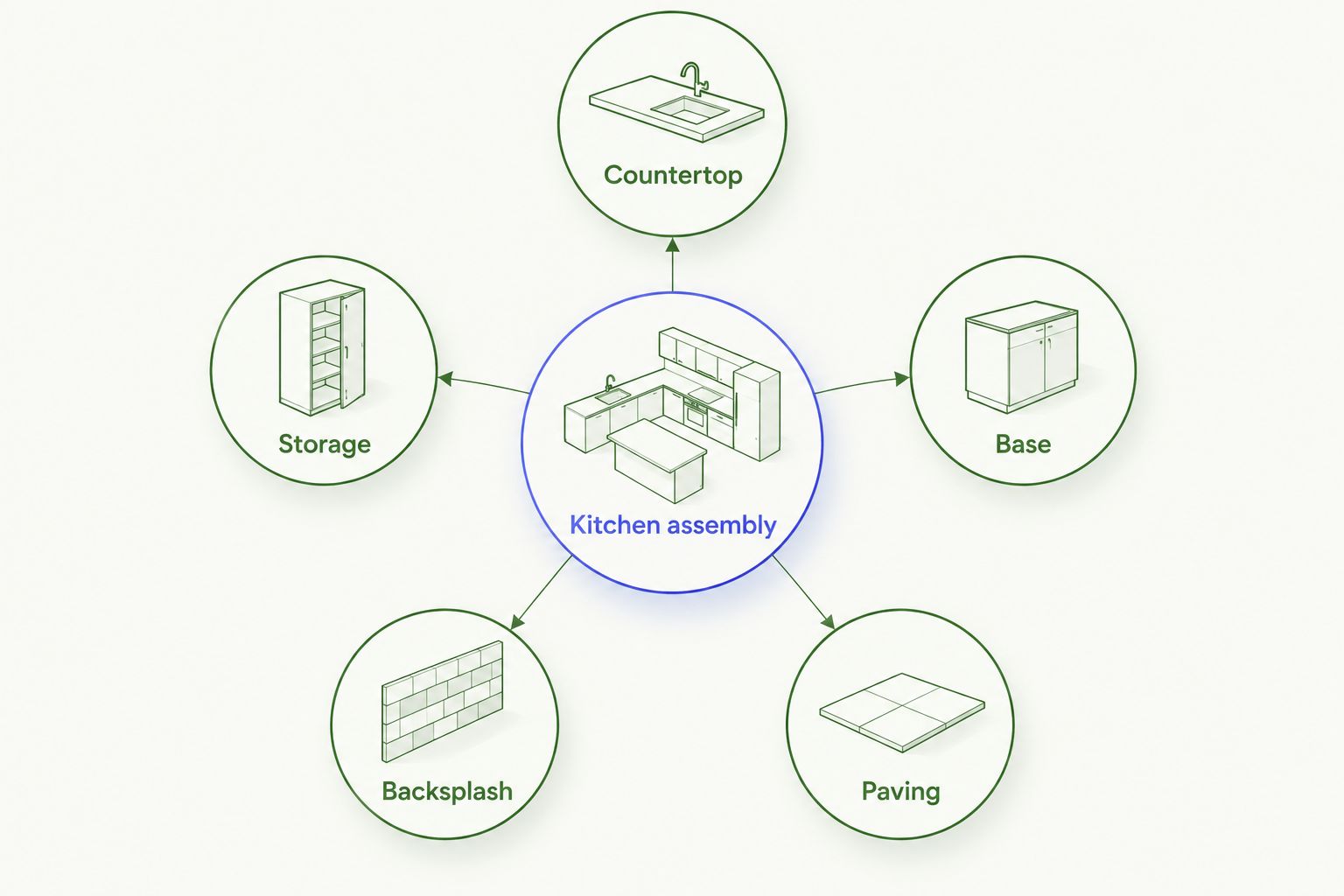
Think of the kitchen as connected components: countertop, storage, base, backsplash, and paving. Each component needs its own specification, even when the finished installation looks like one coordinated design.
1. Outdoor-rated porcelain: best for low-maintenance countertops
Outdoor-rated porcelain slab is the default countertop recommendation for this guide. Its nonporous surface simplifies routine cleaning, and slab construction avoids the repeated grout joints of a tiled worktop. Confirm exterior approval for the exact slab and installation system.
Porcelain still needs careful detailing. Exposed edges, sink openings, and appliance cutouts require appropriate fabrication and support; selecting the surface does not settle those construction questions.
Porcelain pros:
- Nonporous surface for food-preparation cleanup.
- Large-format construction reduces countertop joints.
- Finish choices support restrained or stone-look designs.
Porcelain cons:
- Edges are vulnerable to impact damage.
- Fabrication and repairs require material-specific expertise.
- Outdoor suitability must be checked product by product.
Best for: Homeowners who want a countertop with straightforward routine care and fewer joints.
Choose a finish after inspecting an actual sample for glare and appearance. Keep hot cookware on a suitable trivet rather than treating any countertop as a substitute for a heat-protection surface.
Verdict: Buy outdoor-rated porcelain when low-maintenance cleanup is your priority.
2. Granite: best for natural-stone countertops
Granite is the stronger choice when you want natural variation rather than a manufactured pattern. Individual slabs differ, so inspect the material you intend to use instead of approving only a small reference sample.
For a 2026 outdoor kitchen, confirm the slab's suitability, any applied treatments, and the fabricator's care instructions. Granite porosity varies; sealing requirements should follow the selected stone rather than a universal calendar.
Granite pros:
- Natural patterns make each slab distinct.
- Stone provides a substantial countertop appearance.
- Suitable slabs work well in exterior countertop applications.
Granite cons:
- Some slabs absorb liquids and need sealing.
- Heavy slabs require appropriate support.
- Dark finishes exposed to sun require attention to touch comfort.
Best for: Homeowners who value natural stone and accept material-specific upkeep.
Compare granite with kitchen countertop materials for Arizona homes, but keep indoor and outdoor approvals separate. An interior countertop recommendation does not establish exterior suitability.
Verdict: Buy granite for its natural character; skip it if you want to avoid sealing decisions.
3. Stainless steel: best for outdoor cabinet fronts
Stainless steel is a practical choice for outdoor doors, drawer fronts, and access panels. It provides washable metal surfaces without relying on painted wood or interior cabinet finishes. Specify an outdoor cabinet system, not just stainless-looking fronts attached to unsuitable boxes.
The metal grade, hardware, enclosure design, and cleaning instructions all matter. Stainless steel resists corrosion, but it is not immune to surface staining or damage from unsuitable cleaners.
Stainless steel pros:
- Grease and dust can be cleaned from exposed surfaces.
- Metal fronts avoid the upkeep of wood finishes.
- Access panels allow utilities to remain serviceable.
Stainless steel cons:
- Fingerprints and scratches remain visible.
- Exposed metal can become uncomfortable to touch in sun.
- Doors alone do not make an enclosure watertight.
Best for: Homeowners prioritizing accessible storage and washable cabinet fronts.
Ask how the cabinet assembly handles rain, ventilation, hinges, and access to connections. Keep storage requirements separate from appliance ventilation requirements; one does not replace the other.
Verdict: Buy outdoor-designed stainless steel cabinetry; skip indoor boxes with decorative metal fronts.
4. Concrete masonry: best for permanent island bases
Concrete masonry provides a noncombustible base for a permanent outdoor kitchen island. It suits projects where the layout is settled and the supporting construction can accommodate the assembly.
The base still needs properly detailed openings, countertop support, utility access, and a compatible exterior finish. Noncombustible construction does not remove the obligation to follow each appliance's clearance and ventilation instructions.
Concrete masonry pros:
- Provides a substantial, permanent enclosure.
- Accepts compatible exterior finish systems.
- Offers a noncombustible base material.
Concrete masonry cons:
- Heavy construction requires foundation assessment.
- Moving the island later is difficult.
- Poorly planned openings complicate repairs and servicing.
Best for: Homeowners committed to a fixed cooking layout rather than a movable setup.
Resolve plumbing, electrical, and fuel access before enclosing the base. Ask the contractor to explain how a technician will reach connections after the countertop and finish are installed.
Verdict: Buy masonry for a permanent island; wait if the layout or utility plan remains undecided.
5. Exterior-rated porcelain tile: best for decorative backsplashes
Exterior-rated porcelain tile gives you a washable backsplash with more freedom in pattern and scale than a single slab. Use a tile, substrate, adhesive, and grout system suited to the intended exterior exposure.
A tiled backsplash is an assembly, not just a decorative face. Movement joints and moisture detailing belong in the plan before installation begins.
Porcelain tile pros:
- Offers varied colors, textures, and layouts.
- Glazed surfaces simplify everyday grease cleanup.
- Individual pieces provide a defined repair unit.
Porcelain tile cons:
- Grout joints require additional cleaning.
- Textured finishes retain dirt more readily than smooth ones.
- Repairs depend on obtaining a suitable matching tile.
Best for: Homeowners who want a decorative backsplash without making the countertop visually busy.
Select a surface you can wipe clean around the cooking area. Confirm appliance clearances independently: tile over a combustible wall does not automatically make that wall suitable beside a grill.
Verdict: Buy exterior-rated porcelain tile for backsplash detail; skip rough textures where grease collects.
6. Broom-finished concrete: best for work-area paving
Broom-finished concrete provides a continuous paved area around a backyard cooking zone. Its textured finish is a practical alternative to a highly polished surface, but finish alone does not guarantee slip resistance.
Drainage and joint planning deserve as much attention as appearance. Water should not collect where you stand to cook or flow toward cabinet interiors and adjacent building openings.
Broom-finished concrete pros:
- Creates a continuous work-area surface.
- Avoids repeated paving-unit joints underfoot.
- Provides texture without a polished finish.
Broom-finished concrete cons:
- Concrete can crack despite appropriate construction.
- Grease stains require prompt attention.
- Incorrect drainage is difficult to correct after placement.
Best for: Homeowners planning new paving around a permanent outdoor kitchen.
Evaluate existing concrete before deciding to replace it. A material change is not automatically necessary when the current surface is sound and the proposed layout works with its drainage.
Verdict: Buy broom-finished concrete for new work-area paving; hold if existing paving already meets the project's needs.
How these materials are ranked
This 2026 ranking prioritizes documented exterior suitability, cleaning, support requirements, and repair access. It separates countertop choices from cabinet, base, backsplash, and paving choices so you can assemble a kitchen rather than compare unrelated materials as substitutes.
The recommendations are material-selection guidance, not product testing or a contractor quotation. Product documentation and the site's construction requirements determine the final specification.
Which outdoor kitchen materials should you choose?
Choose outdoor-rated porcelain as the default countertop, then specify the remaining components independently. Select granite instead when natural stone matters more to you than minimizing maintenance decisions. Use outdoor-designed stainless steel fronts where accessible storage is important and masonry where a permanent base suits the layout.
Before requesting a 2026 proposal, prepare 1 consolidated appliance schedule listing the intended grill, sink, refrigeration, and other equipment. Include manufacturer installation instructions so openings, utilities, and clearances are planned around actual equipment—not assumptions.
Request 2 comparable written scopes if you are comparing contractors. Each scope should address the same work:
- Site preparation: Existing surfaces, removals, and supporting construction.
- Material specification: Exact exterior-approved products and compatible installation components.
- Utility coordination: Required connections, service access, and applicable approvals.
- Finish details: Edges, joints, drainage, transitions, and cleanup responsibilities.
First Choice Renovation LLC emphasizes reliable communication, showing up, craftsmanship, experience, and competitive pricing—not a lowest-price guarantee. Describe whether your project involves isolated repairs or broader renovation work, then confirm responsibilities in writing.
Discuss your backyard project
Describe your materials, existing repairs, and remodeling needs, then confirm the proposed scope.
FAQ
What's the best outdoor kitchen countertop for Casa Grande?
Outdoor-rated porcelain is the default recommendation for low-maintenance countertop care. Confirm exterior approval, fabrication requirements, and support details for the specific product before ordering.
Is granite better than porcelain for an outdoor kitchen?
Granite is better for homeowners who prioritize natural-stone character; outdoor-rated porcelain is the default for simpler routine care. Granite's porosity and sealing needs vary by slab.
Can I use indoor quartz outside?
Do not use indoor-only quartz outside. Choose a product explicitly approved by its manufacturer for the intended exterior application and exposure.
Are stainless steel outdoor cabinets maintenance-free?
Stainless steel outdoor cabinets still need cleaning and care. Check the complete cabinet system's exterior suitability, hardware, drainage, and recommended cleaning methods.
Does a covered patio make indoor materials safe outside?
A covered patio does not establish exterior suitability for indoor-only materials. The specific product and installation system still need approval for their intended exposure.
Do I need approval before building an outdoor kitchen?
Confirm applicable permit and approval requirements before construction. Provide the local authority with the project scope, including proposed electrical, plumbing, fuel, and structural work.
Can First Choice Renovation LLC help with repairs and remodeling together?
First Choice Renovation LLC provides remodeling, renovation, and maintenance or handyman services for homeowners and businesses. Describe the backyard work and any related repairs, then confirm which tasks belong in the proposed scope.
One last thing
Specify repair access before approving the finished appearance. A well-selected countertop becomes a problem if reaching a valve or connection requires dismantling the island. Ask where the access panels belong, how doors open, and what remains reachable after the appliances are installed.
That question turns a materials discussion into a usable construction plan. Resolve it before work starts.