Best overall: engineered quartz. Best for a sun-exposed kitchen: porcelain, with manufacturer approval for the exposure. Best for a straightforward surface refresh: laminate. This 2026 guide compares the best kitchen countertop materials for Arizona homes and explains what to discuss with First Choice Renovation LLC before choosing a surface.
- Engineered quartz leads the best kitchen countertop materials for Arizona homes when everyday care matters most.
- Porcelain suits sun-exposed kitchens when the selected product is approved for that exposure.
- Granite suits cooks who want natural stone and accept material-specific sealing requirements.
- First Choice Renovation LLC provides kitchen remodeling for Casa Grande homeowners planning countertop replacement.
Why this matters
An Arizona address does not make every kitchen countertop an outdoor surface. Direct sunlight through a window, contact with hot cookware, and water around the sink are separate conditions. Choose for the conditions at your countertop, not a blanket claim that a material handles desert heat.
The surrounding kitchen matters just as much. A countertop replacement involves cabinet support, sink fit, faucet openings, seams, and the backsplash. Choose the material and installation details together, rather than approving a slab before confirming how it fits your kitchen.
What makes the best kitchen countertop material?
Use these criteria for your 2026 shortlist:
- Everyday care: Decide whether you want routine cleaning alone or accept sealing and finish maintenance.
- Heat tolerance: Compare the manufacturer's instructions for hot cookware; heat resistance is not permission to skip trivets.
- Sun exposure: Check the actual product's guidance when direct sunlight reaches the surface.
- Water management: Evaluate sink edges, joints, and exposed substrate, not just the countertop face.
- Repair options: Ask how scratches, chips, burns, and stains are handled in the selected finish.
- Installation fit: Confirm cabinet condition, edge details, cutouts, and support requirements before ordering.
Bring home 2 material samples from your shortlist. Compare them beside your cabinet finish under daylight and your evening lighting. A showroom display does not reproduce either condition.
Kitchen countertop materials at a glance
This 2026 ranking assigns each material a distinct use case. The order reflects convenience for an everyday indoor kitchen, not a claim that one surface wins every comparison.
| Material | Best for | Standout feature | Key limitation |
|---|---|---|---|
| Engineered quartz | Low-maintenance daily use | Nonporous surface that does not require sealing | Heat and sunlight guidance varies by product |
| Granite | Natural stone with strong heat tolerance | Natural pattern variation | Some selections require sealing |
| Porcelain | Sun-exposed layouts | UV resistance and low water absorption | Edges and cutouts need careful fabrication |
| Solid surface | Repairability and discreet seams | Many surface marks can be refinished | Heat and scratching require care |
| Laminate | A straightforward surface refresh | Broad selection of decorative finishes | Damaged seams and burns are difficult to repair |
| Butcher block | A dedicated preparation zone | Wood can be sanded and refinished | Moisture and finish upkeep need attention |
| Marble | A kitchen that welcomes patina | Distinctive natural veining | Acids etch the surface |
1. Engineered quartz: best for low-maintenance daily use
Engineered quartz combines mineral content with binders to create a nonporous countertop. It does not require the sealing associated with some natural stones. For an indoor kitchen where easy cleaning takes priority, it is the default recommendation.
Quartz is not heatproof. Protect it from hot cookware, and check the selected manufacturer's sunlight restrictions before placing it beside a strongly exposed window.
Engineered quartz pros:
- Does not require routine sealing.
- Offers consistent patterns for coordinating adjoining surfaces.
- Supports straightforward everyday cleaning with approved products.
Engineered quartz cons:
- Direct heat can damage the surface or binders.
- Sunlight suitability depends on the specific product.
- Chips and seam placement still require attention.
Best for: Homeowners who want an easy-care indoor countertop rather than natural stone maintenance.
Choose the sample for both its pattern and finish. A matte finish and a polished finish can show fingerprints and cleaning marks differently, so inspect the actual selection rather than relying on a small photograph.
Verdict: Buy engineered quartz for everyday indoor use after confirming heat and sunlight instructions.
2. Granite: best for natural stone and frequent cooking
Granite is a natural stone with patterns that vary between slabs. It tolerates heat better than resin-bound surfaces, but trivets remain the sensible way to protect the countertop and surrounding installation.
Absorption varies by stone. Ask whether the chosen slab needs sealing and which cleaning products suit it; do not accept a universal maintenance schedule for every granite selection.
Granite pros:
- Gives you a genuinely natural pattern.
- Provides strong heat resistance.
- Offers a hard surface suited to routine kitchen use.
Granite cons:
- Some selections require sealing.
- Slab variation makes sample-only decisions incomplete.
- Edge impacts can cause chips.
Best for: Cooks who want natural stone and accept selection-specific maintenance.
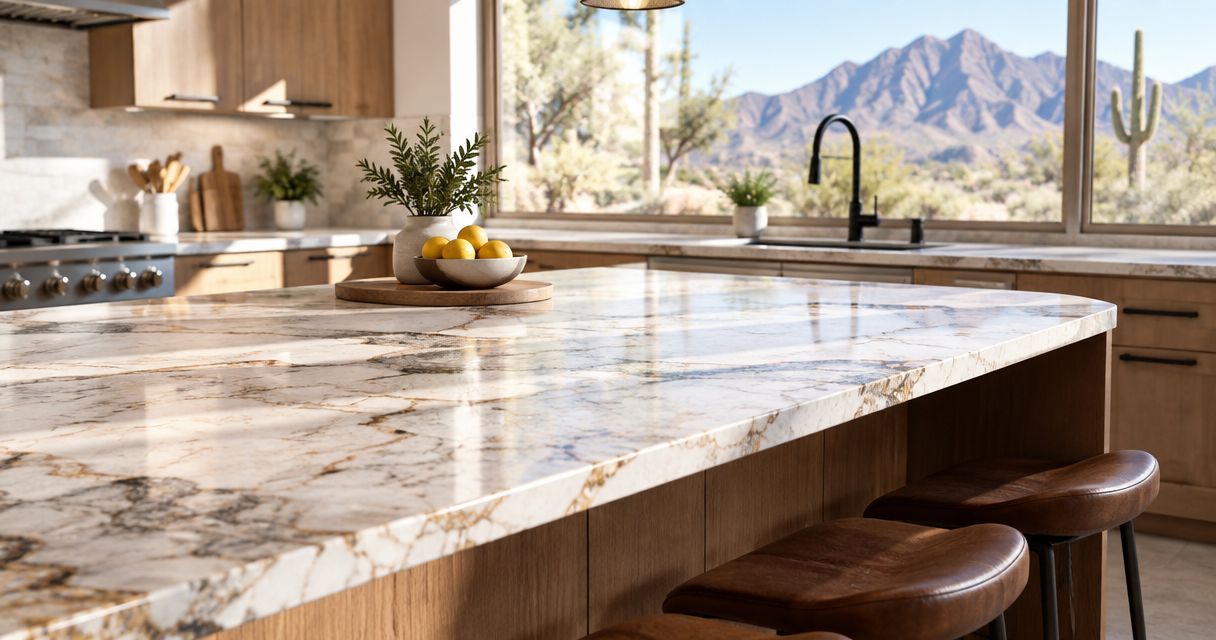
View the actual slab when possible. Identify where prominent veins, color changes, and seams will fall, particularly around a kitchen island or a long sink run.
Verdict: Buy granite when natural variation matters and you accept its care requirements.
3. Porcelain: best for sun-exposed kitchen layouts
Porcelain countertops provide low water absorption and resistance to ultraviolet light. They deserve a place on the shortlist when direct sunlight is a major consideration in an Arizona kitchen.
The selected product and fabrication details still control the decision. Check exposure approval, edge construction, and sink cutouts rather than assuming every porcelain slab has identical installation requirements.
Porcelain pros:
- Resists UV-related color change.
- Does not require stone-style sealing.
- Offers heat resistance and low water absorption.
Porcelain cons:
- Edge impacts can cause chips.
- Fabrication and cutouts require careful handling.
- Surface decoration does not always continue through the edge.
Best for: Homeowners prioritizing sunlight suitability in a bright kitchen.
Inspect an edge sample as well as the face. The edge can look different from the printed surface, and that difference becomes more noticeable on an island viewed from several directions.
Verdict: Buy porcelain for a sun-exposed layout after confirming product approval and fabrication details.
4. Solid surface: best for repairability and discreet seams
Solid surface countertops use mineral fillers and resin to create a nonporous surface. Fabricators can join sections with discreet seams, and many scratches can be removed through appropriate refinishing.
Repairability is the advantage here, not immunity to damage. Hot cookware and abrasive treatment still require care.
Solid surface pros:
- Does not require sealing.
- Allows many surface marks to be refinished.
- Supports discreet joints between sections.
Solid surface cons:
- Direct heat can cause damage.
- Scratches can become visible during daily use.
- Refinishing changes the surface and should follow product guidance.
Best for: Homeowners who prioritize a repairable finish over maximum scratch resistance.
Ask what a repair would involve for the exact color and finish. A repairable surface is useful only when you understand which damage can be corrected and who should perform the work.
Verdict: Buy solid surface when repairability and discreet seams outweigh heat sensitivity.
5. Laminate: best for a straightforward surface refresh
Laminate countertops have a decorative surface bonded to a supporting substrate. They offer many colors and patterns without requiring natural stone selection.
The critical details are the seams, edges, and sink opening. Water entering an exposed substrate can cause damage that cleaning or polishing will not correct.
Laminate pros:
- Offers a broad range of decorative finishes.
- Does not need sealing.
- Works for a surface-focused kitchen update.
Laminate cons:
- Hot cookware can burn or damage the surface.
- Deep scratches and burns are difficult to repair.
- Water intrusion at vulnerable joints can damage the substrate.
Best for: Homeowners retaining a serviceable kitchen layout and focusing on a surface refresh.
Confirm the edge profile and backsplash transition before approving the finish. Those details influence the finished appearance as much as the printed pattern.
Verdict: Buy laminate for a focused refresh when you accept its repair and moisture limitations.
6. Butcher block: best for a dedicated preparation zone
Butcher block brings a wood work surface into the kitchen. Depending on its construction and finish, it can be sanded and refinished when wear becomes visible.
Its strongest use case is a deliberate work zone, not an automatic replacement for every countertop. Areas around sinks demand particular attention to moisture protection and finish maintenance.
Butcher block pros:
- Offers a wood surface with natural variation.
- Can often be sanded and refinished.
- Works as a contrasting preparation area.
Butcher block cons:
- Standing water can damage wood and joints.
- Heat and knives can leave marks.
- Care requirements depend on the finish.
Best for: Homeowners who want a dedicated wood preparation area and accept ongoing upkeep.
Decide whether the surface will be used for direct food preparation. Follow the finish manufacturer's food-contact and maintenance instructions; decorative wood counters and cutting surfaces do not automatically share the same care routine.
Verdict: Buy butcher block for a planned work zone; skip it if maintenance is unwelcome.
7. Marble: best for homeowners who welcome patina
Marble provides natural veining and a distinctive stone appearance. Its main kitchen limitation is etching: acids such as lemon juice can react with the stone and leave dull marks.
Sealing helps manage absorption, but it does not prevent acid etching. Choose marble only if normal surface change fits your expectations.
Marble pros:
- Provides distinctive natural veining.
- Offers a stone surface with individual character.
- Can develop a patina that some homeowners prefer.
Marble cons:
- Acids etch the surface.
- Staining requires attention to spills and care.
- Scratches and visible wear are part of the decision.
Best for: Homeowners who value natural character more than a consistently unmarked finish.
Look at examples of used marble, not only newly installed slabs. An untouched showroom sample does not show how the surface responds to ordinary kitchen use.
Verdict: Buy marble if you welcome patina; skip it if visible etching will frustrate you.
How the ranking works
The 2026 ranking prioritizes everyday care first, then exposure suitability, repair options, and installation fit. Engineered quartz leads for routine indoor use because it avoids sealing; the other materials earn their places through distinct advantages rather than a universal performance score.
No countertop eliminates the need for sensible care. Heat resistance, stain resistance, and scratch resistance are different properties. Compare each separately before treating a product description as a complete specification.
Check the installation before choosing the slab
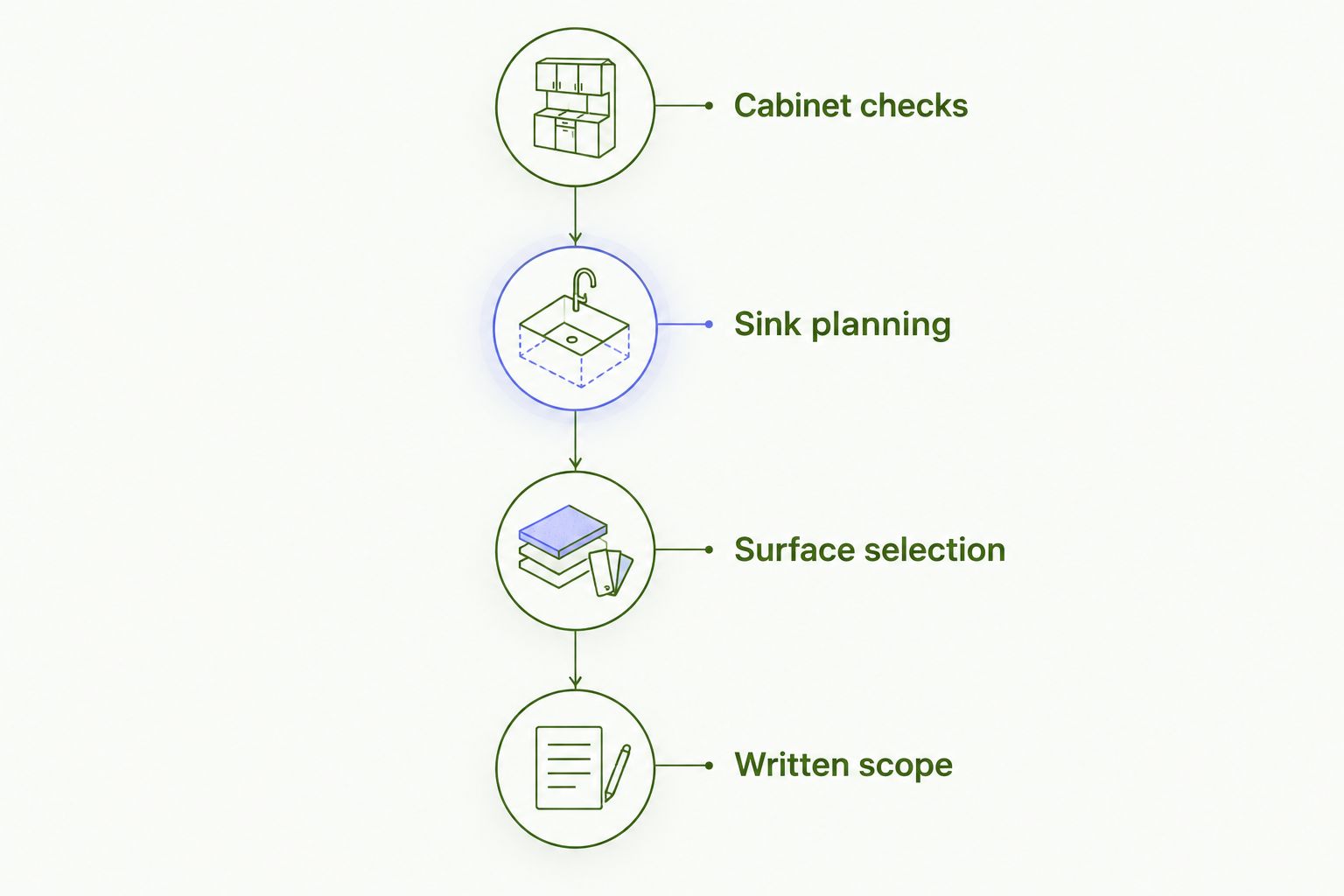
Use this sequence before approving your 2026 countertop selection:
- Cabinet checks: Complete 3 cabinet checks: condition, level, and support suitability. Ask the installer to identify repairs before fabrication.
- Sink planning: Confirm the sink model, mounting arrangement, faucet openings, and any accessories that need cutouts.
- Surface selection: Match the material to sunlight, cooking habits, and the cleaning routine you will actually follow.
- Written scope: Request 1 written scope covering removal, installation, seams, edges, plumbing coordination, and backsplash treatment.
These checks connect the countertop decision to the rest of the remodel. First Choice Renovation LLC provides kitchen remodeling and maintenance work; discuss whether your project involves only surface replacement or additional repairs and renovation work.
Your quote request should identify the property location, existing countertop, preferred material, and any planned sink or layout changes. Include photographs and describe known damage rather than leaving those details for assumptions.
Discuss your kitchen remodel
Share your countertop goals, existing kitchen conditions, and planned changes.
Which countertop material should you choose?
Choose engineered quartz as the default for an indoor kitchen where easy care comes first. Choose porcelain when sunlight suitability leads the decision, granite for natural stone, and solid surface when repairability matters most.
Laminate suits a focused refresh. Butcher block suits a dedicated preparation zone. Marble suits a homeowner who welcomes visible aging rather than expecting an unchanged surface.
First Choice Renovation LLC is a fit for Casa Grande homeowners planning kitchen remodeling alongside countertop replacement. Start the conversation with how you use the kitchen, not just a photograph of the finish you like.
FAQ
What's the best kitchen countertop material for Arizona homes in 2026?
Engineered quartz is the default choice for everyday indoor kitchens when low maintenance matters most. Porcelain deserves priority when direct sunlight is a key concern, subject to the selected product's exposure guidance.
Is quartz better than granite for an Arizona kitchen?
Quartz is better for homeowners who want a countertop that does not require sealing. Granite is better for those who prefer natural stone variation and accept its selection-specific care requirements.
Can I put a hot pan directly on a quartz countertop?
Use a trivet rather than placing a hot pan directly on quartz. Direct heat can damage its binders or surface, and the selected manufacturer's care instructions should control your routine.
Does granite need to be sealed every year?
Granite does not have a universal annual sealing requirement. Absorption varies by stone, so follow guidance for the actual selection rather than applying a fixed schedule to every slab.
Is porcelain a good choice beside a sunny kitchen window?
Porcelain is a strong candidate beside a sunny kitchen window because it resists ultraviolet light. Confirm the selected product's approval for the exposure and discuss edge and cutout details with the fabricator.
Will sealing stop marble from etching?
Sealing does not stop marble from etching. Acidic foods can react with the stone even when it is sealed; sealing addresses absorption rather than that chemical reaction.
Can I replace countertops without replacing my cabinets?
You can retain existing cabinets when their condition and support meet the new countertop's requirements. Have the installer assess the cabinets before fabrication, and confirm how removal affects the sink and backsplash.
Who can help plan kitchen remodeling in Casa Grande?
First Choice Renovation LLC provides kitchen remodeling for Casa Grande homeowners. Describe your countertop preferences, existing kitchen conditions, and any related renovation or repair work when requesting a quote.
One last thing
An edge sample can change your decision more than another photograph of the slab. Ask to see the proposed edge, especially for patterned porcelain, laminate, or a heavily veined stone. You will see that edge every day, and its appearance is not always obvious from a face sample.