Best overall: porcelain tile; best for standing comfort: luxury vinyl plank; best for decorative patterns: ceramic tile. For your 2026 kitchen project, First Choice Renovation LLC provides kitchen remodeling services in Casa Grande; this guide compares flooring materials by cleanup, comfort, installation requirements, and their fit with adjoining rooms.
- Porcelain tile leads the best flooring options for Casa Grande kitchens when spill resistance and easy cleanup come first.
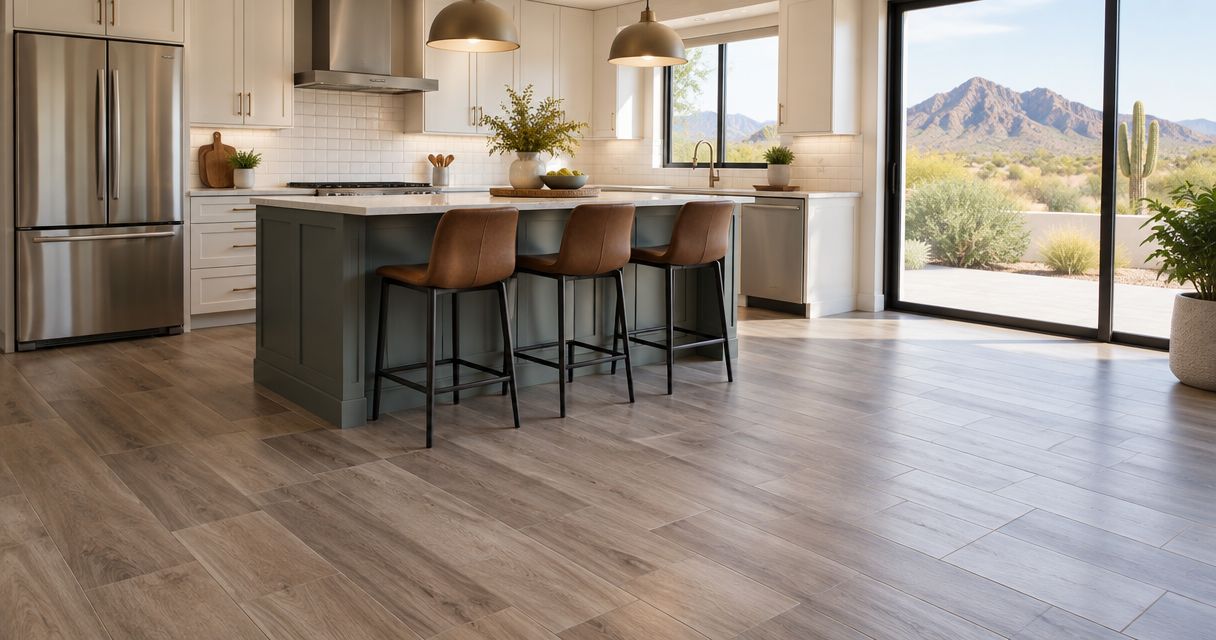
- Luxury vinyl plank is best for homeowners who want a softer-feeling kitchen floor than tile.
- Engineered wood suits connected living spaces but requires stricter spill management than porcelain tile.
- First Choice Renovation LLC handles kitchen remodeling; discuss floor preparation, transitions, and installation scope before requesting a quote.
Why this matters
A kitchen floor has to do more than match your cabinets. It must tolerate cooking spills, chair movement, tracked-in dirt, and repeated cleaning while meeting the needs of everyone who uses the room.
For Casa Grande homeowners planning a 2026 remodel, the best flooring decision starts with the existing floor and your daily routine—not a sample photograph. A hard surface that cleans easily can still feel uncomfortable during meal preparation. A softer surface can introduce restrictions around heavy appliances or fixed cabinetry.
First Choice Renovation LLC is a kitchen remodeling option for Casa Grande homeowners who need flooring considered alongside cabinets, appliances, and adjoining rooms. Treat the material choice and installation scope as one decision.
What makes the best kitchen flooring?
Use these criteria before comparing colors or patterns:
- Spill tolerance: Separate the surface's resistance to water from the complete floor assembly's protection against leaks.
- Cleaning requirements: Check the manufacturer's approved cleaners, grout care, and restrictions on steam cleaning.
- Standing comfort: Consider how the floor feels during cooking, especially if you spend long periods at the counter.
- Surface traction: Evaluate the exact finish. A material name alone does not establish whether a floor is suitable when wet.
- Installation fit: Check substrate preparation, floor height, appliance clearance, and transitions into adjoining rooms.
- Repairability: Ask whether damaged pieces can be replaced and whether matching material should be retained.
For your 2026 selection, compare 3 flooring samples in the actual kitchen. Review them during 2 viewing sessions, one in daylight and one under your evening lighting. These are practical selection steps, not product performance benchmarks.
Kitchen flooring options at a glance
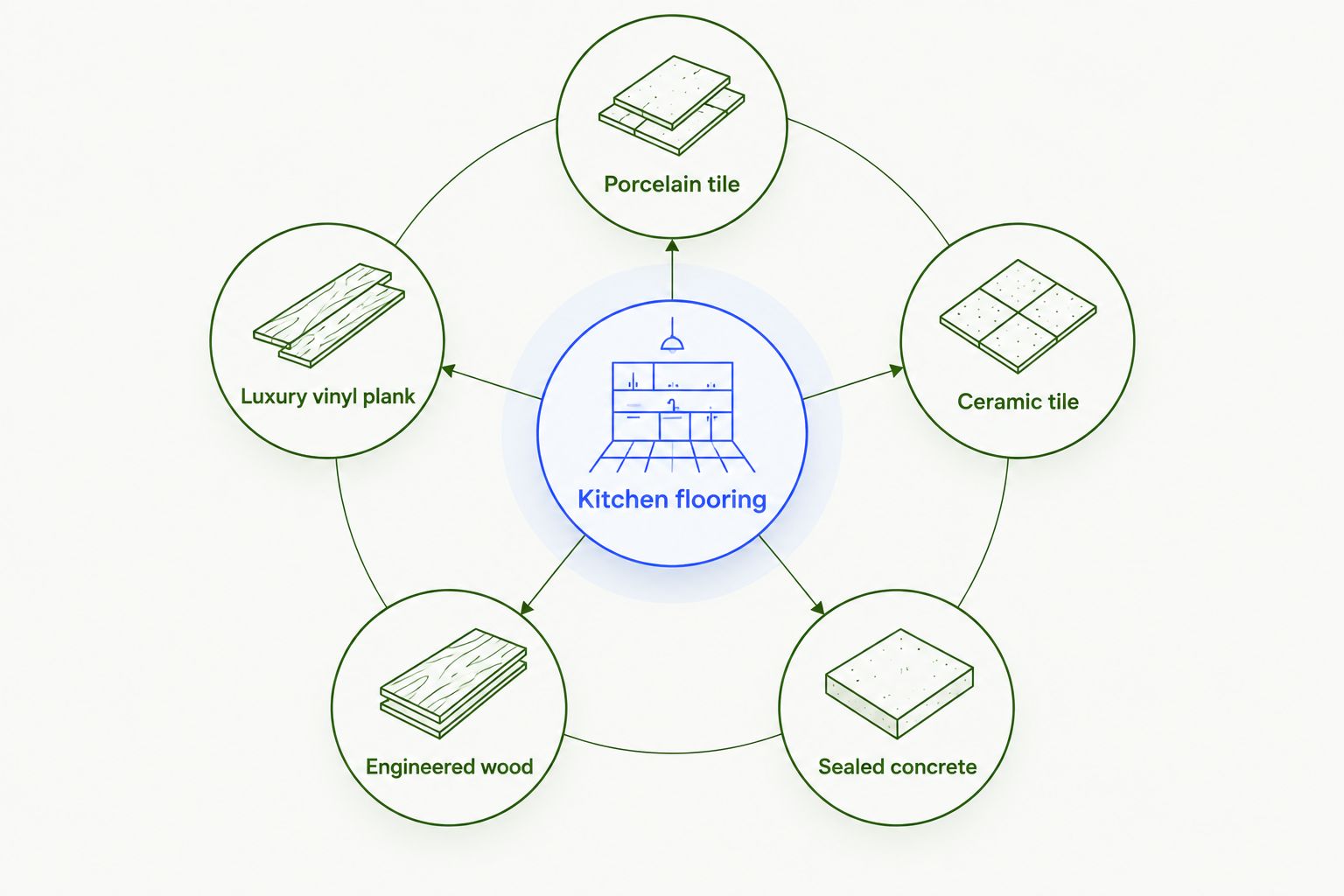
| Rank and material | Best for | Standout feature | Key limitation |
|---|---|---|---|
| 1. Porcelain tile | Spill-prone, frequently cleaned kitchens | Low water absorption and a hard surface | Hard underfoot; grout needs attention |
| 2. Luxury vinyl plank | Standing comfort and wood-look styling | More forgiving feel than tile | Product-specific restrictions and heat sensitivity |
| 3. Ceramic tile | Decorative patterns and distinctive layouts | Broad design choices | Performance varies; edges can chip |
| 4. Engineered wood | Kitchens connected to wood-floored living areas | Real wood surface | Standing water can damage the floor |
| 5. Sealed concrete | Minimal seams over a suitable existing slab | Uses the slab as the finished surface | Cracks and repairs can remain visible |
No material wins every category. Choose porcelain tile for wet cleanup, luxury vinyl plank for comfort, ceramic tile for pattern, engineered wood for continuity, or sealed concrete when the existing slab supports the finish you want.
1. Porcelain tile: best kitchen flooring for spill resistance
Porcelain tile is the strongest default recommendation when your priorities are spill cleanup and a hard-wearing surface. Its performance still depends on choosing a floor-rated product and installing it over a suitable substrate.
ANSI A137.1 defines porcelain tile by water absorption of 0.5% or less. That classification describes the tile itself; it does not make grout, joints, or the entire kitchen floor waterproof.
Porcelain tile pros:
- Low water absorption supports use in kitchens where spills are routine.
- A hard surface tolerates regular cleaning with approved products.
- Wood-look, stone-look, and plain finishes support different kitchen designs.
Porcelain tile cons:
- The surface feels hard during extended standing, and dropped dishes can break.
- Grout and movement joints require proper installation and ongoing care.
Best for: Busy household kitchens where cleanup takes priority over softness underfoot.
Ask for the exact product's floor-use designation and traction information. Do not assume that a polished finish performs like a textured finish, or that tile will correct an uneven substrate.
Verdict: Buy porcelain tile for your 2026 remodel when spill resistance and straightforward surface cleaning are your priorities.
2. Luxury vinyl plank: best kitchen flooring for standing comfort
Luxury vinyl plank provides a wood-look floor with a more forgiving feel than tile. It suits homeowners who want a practical kitchen surface without the hardness of ceramic or porcelain.
Construction and installation instructions differ between products. A water-resistant or waterproof plank claim does not establish that the installed floor will protect the substrate during an appliance leak.
Luxury vinyl plank pros:
- Feels less hard underfoot than tile during cooking and cleanup.
- Provides a wood-look option without a real wood surface.
- Individual planks offer a defined replacement unit, although access depends on installation method.
Luxury vinyl plank cons:
- Sharp objects, dragged furniture, and concentrated loads can damage the surface.
- Direct sunlight, heat, and fixed cabinetry can create product-specific installation restrictions.
Best for: Homeowners who prioritize standing comfort and wood-look styling.
For a Casa Grande kitchen, review exposure near glazed doors and windows against the manufacturer's temperature and sunlight limits. Confirm whether the selected floor is floating or glued down before deciding how it will meet cabinets and appliances.
Verdict: Buy luxury vinyl plank when comfort leads the decision and the selected product fits your kitchen's installation conditions.
3. Ceramic tile: best kitchen flooring for decorative patterns
Ceramic tile suits kitchens where a patterned floor or distinctive layout carries the design. Choose a tile explicitly rated for floors; wall tile is not an interchangeable substitute.
Ceramic and porcelain are related materials, but they are not identical classifications. Check the particular ceramic tile's water absorption, intended use, and surface finish rather than judging performance from appearance.
Ceramic tile pros:
- Supports patterned layouts, contrasting borders, and varied color choices.
- Provides a hard surface that can be cleaned with approved products.
- Allows a damaged tile to be replaced when matching material and suitable access are available.
Ceramic tile cons:
- Chipped edges can reveal a different-colored tile body.
- Hardness underfoot and grout maintenance remain part of ownership.
Best for: Homeowners who want the floor pattern to be a defining kitchen feature.
Lay out samples against the cabinet finish before approving the design. A strong pattern needs deliberate placement at doorways, cabinet edges, and visible room boundaries; otherwise, awkward cuts become permanent design details.
Verdict: Buy ceramic tile for a decorative floor, provided the exact tile is rated for your kitchen's intended use.
4. Engineered wood: best kitchen flooring for connected living spaces
Engineered wood has a real wood surface over a layered core. It is a design-led choice when your kitchen opens into living areas and you want visual continuity rather than a separate flooring zone.
Engineered construction does not eliminate wood's sensitivity to moisture. Kitchen suitability depends on the product's instructions and your willingness to clean spills promptly.
Engineered wood pros:
- Creates continuity between the kitchen and adjoining wood-floored rooms.
- Provides real wood grain rather than a printed wood-look surface.
- Some products permit refinishing, depending on their wear layer and manufacturer guidance.
Engineered wood cons:
- Standing water and appliance leaks can damage boards or finishes.
- Refinishing is not available for every product, and scratches require care.
Best for: Open-plan kitchens where matching adjacent wood flooring matters more than maximum spill tolerance.
In a 2026 remodel, verify cleaning instructions and moisture requirements before choosing engineered wood. Do not assume a floor suitable for a living room is automatically approved for the kitchen.
Verdict: Hold until the product's kitchen suitability is confirmed; choose engineered wood only when you accept its moisture-care requirements.
5. Sealed concrete: best kitchen flooring for minimal seams
Sealed concrete uses a suitable concrete slab as the finished floor instead of covering it with separate planks or tiles. It fits homeowners who prefer a continuous-looking surface and accept the slab's existing character.
The slab's condition determines whether this option is practical. Old flooring removal can expose cracks, patches, adhesive residue, or uneven coloring that affect the finished appearance.
Sealed concrete pros:
- Avoids the repeated grout lines associated with a tiled floor.
- Can retain existing slab character as part of the design.
- Offers a finished-floor approach without adding a separate plank or tile layer.
Sealed concrete cons:
- Cracks and repairs can remain visible after finishing.
- The surface stays hard underfoot, and the sealer requires appropriate maintenance.
Best for: Kitchens with a suitable exposed slab and owners who prefer minimal seams over a uniform appearance.
Ask to evaluate the slab before committing to the finish. Sealer selection also matters: appearance, traction, cleaning restrictions, and maintenance requirements belong in the decision.
Verdict: Wait for a slab assessment before choosing sealed concrete; skip it if visible repairs conflict with your expectations.
How these flooring options are ranked
This 2026 ranking prioritizes spill tolerance, cleaning, comfort, installation fit, and repairability. Porcelain tile takes the default position because its low water absorption directly addresses a common kitchen requirement; the other materials win distinct use cases.
The ranking compares material categories, not tested product lines. An unsuitable finish, poor substrate preparation, or incorrect installation can undermine any selection.
What to settle before requesting a flooring quote
A useful flooring quote describes the work underneath and around the visible surface. Ask First Choice Renovation LLC to discuss the kitchen flooring scope alongside any cabinet, appliance, or renovation work you are considering.
Use this checklist to make the request specific:
- Existing floor: Identify the current covering and what needs removal.
- Substrate condition: Discuss flatness, cracks, moisture evaluation, and required preparation.
- Floor height: Check doorway transitions, appliance openings, and adjoining rooms.
- Cabinet sequence: Confirm how the selected flooring system meets fixed cabinets and islands.
- Finish details: Specify grout, trim, thresholds, movement joints, or sealer as applicable.
- Repair material: Discuss retaining matching tiles or planks for future repairs.
For a 2026 project, separate essential preparation from optional design changes in the written scope. Competitive pricing is useful only when you understand what each proposal includes.
Discuss your kitchen flooring project
Ask First Choice Renovation LLC about flooring scope, preparation, and adjoining renovation work.
Which kitchen flooring should you choose?
Choose porcelain tile if you are undecided and want spill resistance to lead the decision. Select a floor-rated finish, confirm traction information, and address the substrate before installation.
Choose luxury vinyl plank instead when standing comfort matters more. Ceramic tile serves decorative layouts, engineered wood serves connected living spaces, and sealed concrete serves suitable slabs where visible character is welcome.
Keep the full project in view. First Choice Renovation LLC provides kitchen remodeling as well as bathroom remodeling, residential and commercial renovations, and maintenance or handyman work; describe both the flooring issue and any related repairs when requesting a quote.
FAQ
What's the best flooring for a Casa Grande kitchen in 2026?
Porcelain tile is the best default choice for a Casa Grande kitchen when spill resistance and easy surface cleaning are your priorities. Luxury vinyl plank is the better fit when standing comfort matters more, provided the selected product suits the installation conditions.
Is porcelain tile better than luxury vinyl plank for kitchens?
Porcelain tile is better for a hard surface with low water absorption; luxury vinyl plank is better for a more forgiving feel underfoot. Compare the exact products' traction, cleaning instructions, and installation requirements before deciding.
Does waterproof vinyl flooring protect against dishwasher leaks?
A waterproof plank claim does not establish that the entire installed floor protects against dishwasher leaks. Water can reach edges, joints, or the substrate, so address the appliance leak rather than relying on the flooring label.
Can engineered wood go in a kitchen?
Engineered wood can go in a kitchen when the manufacturer permits that use and the installation meets its requirements. Clean spills promptly and accept that standing water can damage the boards or finish.
Can I install new kitchen flooring over the existing floor?
Install over an existing floor only when the new flooring manufacturer's instructions permit the existing material and its condition. Check flatness, adhesion, moisture requirements, floor height, and appliance clearance before approving that approach.
Is sealed concrete a good kitchen flooring option?
Sealed concrete is a good option when the slab is suitable and you accept visible cracks, patches, or color variation. Assess the exposed slab and the proposed sealer before committing to the finish.
What should I ask a kitchen remodeling contractor about flooring?
Ask for a written scope covering removal, substrate preparation, installation, transitions, and appliance clearance. Also confirm how the chosen floor meets cabinets and what matching material should be retained for repairs.
One last thing
Check the dishwasher opening before approving the new floor height. A thicker finished floor can reduce removal clearance when the appliance sits below the surrounding floor level.
Record that detail in the installation scope, not as an assumption. A well-chosen material still needs an installation that lets you maintain and replace the appliances around it.